
Students dive in for hands-on class
Topics
Featured
Share online
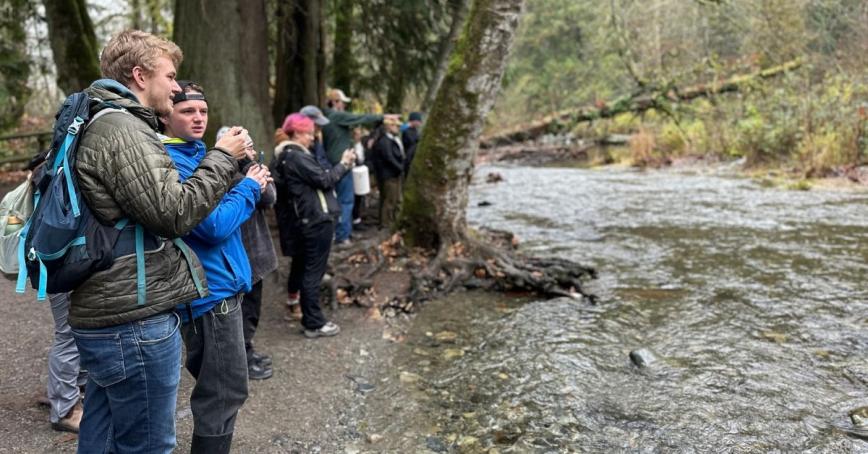
Becky Meyer steps toward the water's edge as a late-autumn mist hangs amongst old-growth giants at Goldstream Provincial Park. Just feet away, tail fins thrash wildly as Coho, Chinook and Chum salmon fight their way upstream.
Each fall, salmon take the long journey back to their natal streams to spawn before they die, following the same instinctive path traced by generations before them.
Meyer, a student in Royal Roads University’s Undergraduate Certificate in Applied Environmental Sciences program, says that while she’s lived on Vancouver Island for about a decade, it’s the first time she’s seen the salmon run. It’s early in the season, so the fish are still active and alive.
“Every time I’ve gone it’s been too late,” she says, snapping photos on her phone. “The West Coast salmon run is a unique experience, especially growing up in Ontario, it’s just not a thing.”
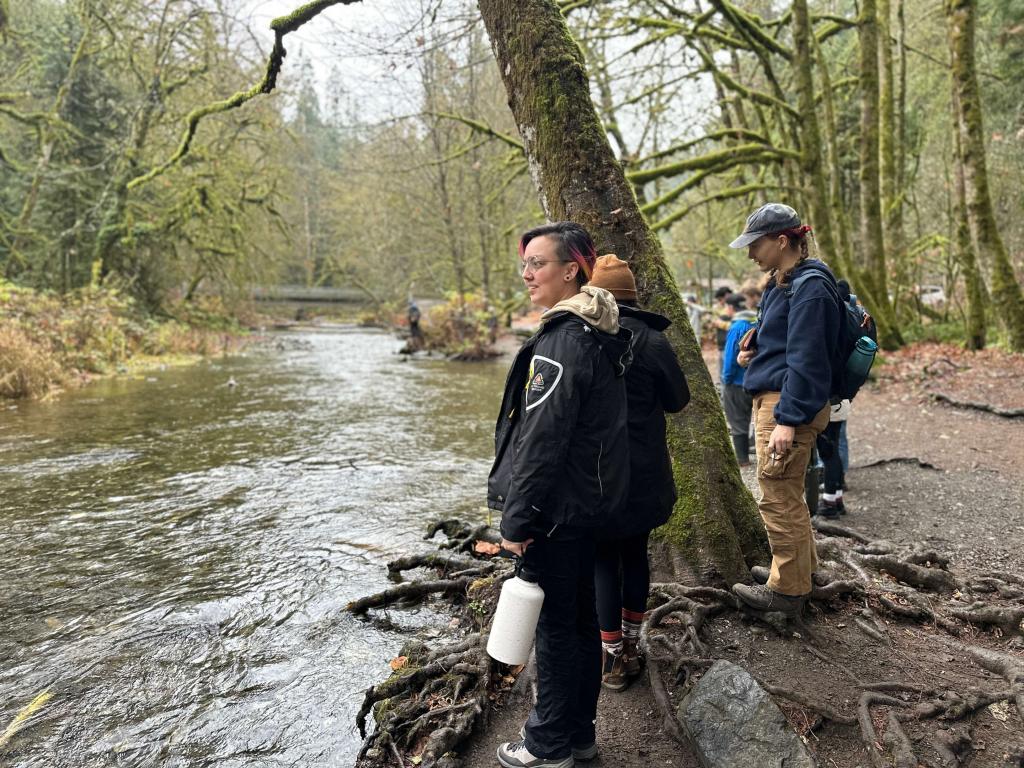
After studying salmon lifecycles in class, Becky Meyer (centre) says she loved seeing them play out firsthand. “It’s so hands-on, which makes the program more effective.”
Forests fed by salmon
As part of their coursework, Environmental Science certificate students along with those in the Bachelor of Science in Environmental Science programs are visiting Goldstream Park and the Goldstream Fish Hatchery to deepen their understanding of salmon lifecycles, migration patterns, and enhancement programs, as well as the vital role salmon play in sustaining the surrounding forest ecosystem.
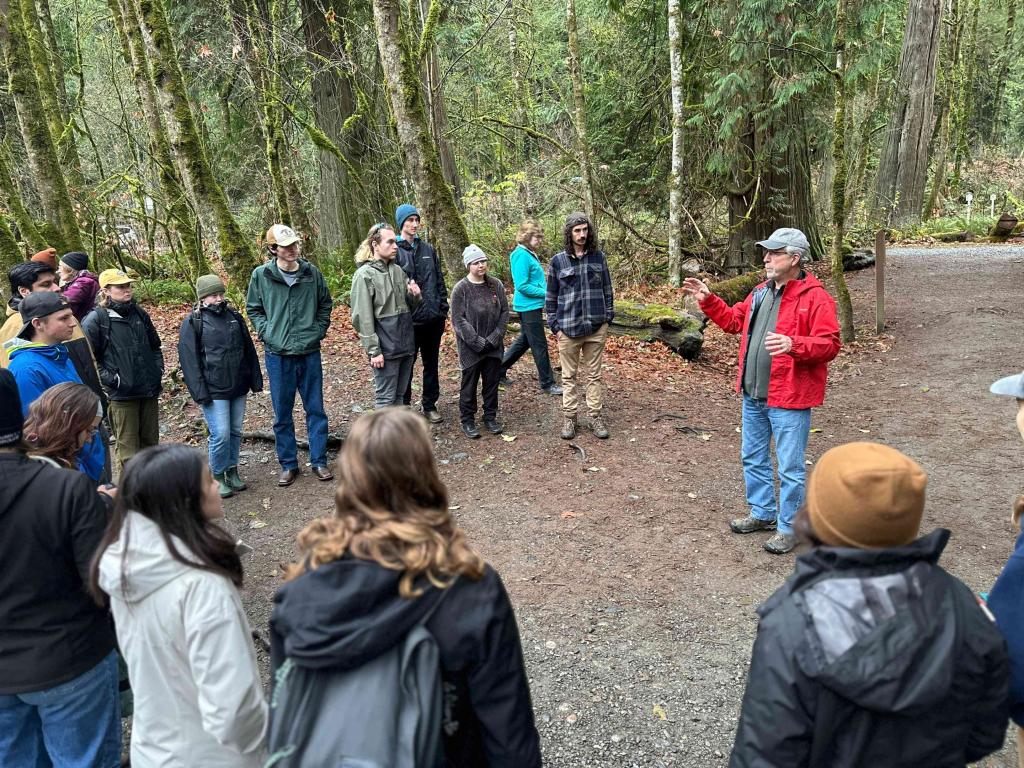
Don Lowen, a member of the Goldstream Volunteer Salmonid Enhancement Association, says in the late 1980s, an average Chum run was between 15,000 to 30,000. This year, he says it’s was closer to 1,500.
Salmon are a keystone species, explains Alison Moran, associate faculty member in the School of Environment and Sustainability.
“The link on this coast between nutrients brought from the ocean and the health of our land ecosystems is incredibly strong,” Moran says.
The annual Goldstream salmon run is an extraordinary display of resilience and survival. But the run is about more than ensuring the survival of the next generation of fish – it's also about ensuring the health of an entire ecosystem, even long after they die.
“Look around you at the lush forests. These only occur because of luxury levels of nitrogen – all derived from the ocean,” Moran says.
Understanding the relationship between salmon health and forest health is a central lesson Moran designed into this field experience.
Since these forests depend on marine-derived nitrogen — in the form of decomposing salmon carcasses — declining levels of returning salmon spell disaster.
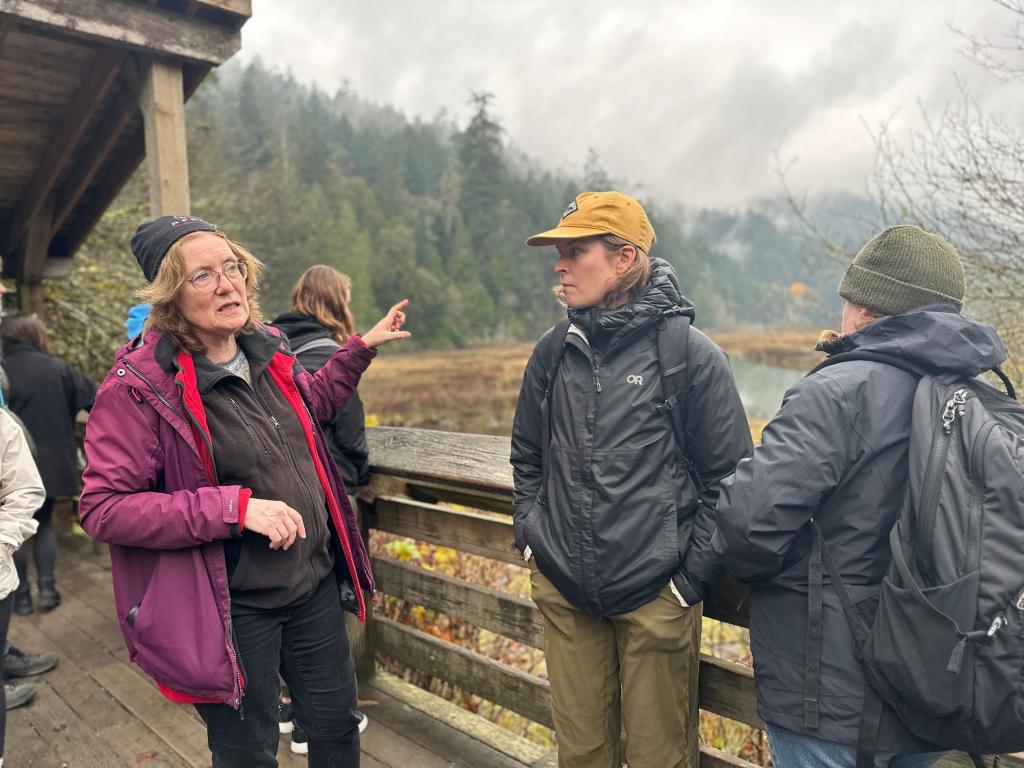
Estuaries like this one at Goldstream help young salmon transition to saltwater, explains Alison Moran (left). When they return to spawn, they’re able to taste the river as they near. Unfortunately, this sense of direction can be disrupted by pollutants.
Hatching a plan for salmon survival
Enter the Goldstream Hatchery, a volunteer-run organization committed to education and increasing stocks of local Coho and Chum salmon.
“It’s been a complete disaster year for chum return,” Don Lowen tells the students.
Lowen, a member of the Goldstream Volunteer Salmonid Enhancement Association, says when he first started working with the river in the late 1980s, an average run was between 15,000 to 30,000.
“This year, we’re probably going to get less than 1,500,” he says.
Increasingly extreme climate events, from heat domes to atmospheric rivers, likely play a role in the dwindling numbers, he says.
For their next stop on their tour, Lowen leads the students through a series of locked gates that restrict access to the Hatchery, which is located within the CRD’s Regional Water Supply Service. These controls help prevent the introduction of invasive species or contaminants that could threaten the watershed’s ecosystem and water quality, underscoring the importance of protecting both the salmon population and the region’s drinking water.
First, students peek inside one of many round tanks at the Hatchery, some up to 12 feet across. This one is temporarily home to male Coho brood stock. Brood stock are collected from a designated fence along the river. They’re then taken to the Hatchery to produce the next generation of salmon fry which will later be returned to the river, Lowen explains.
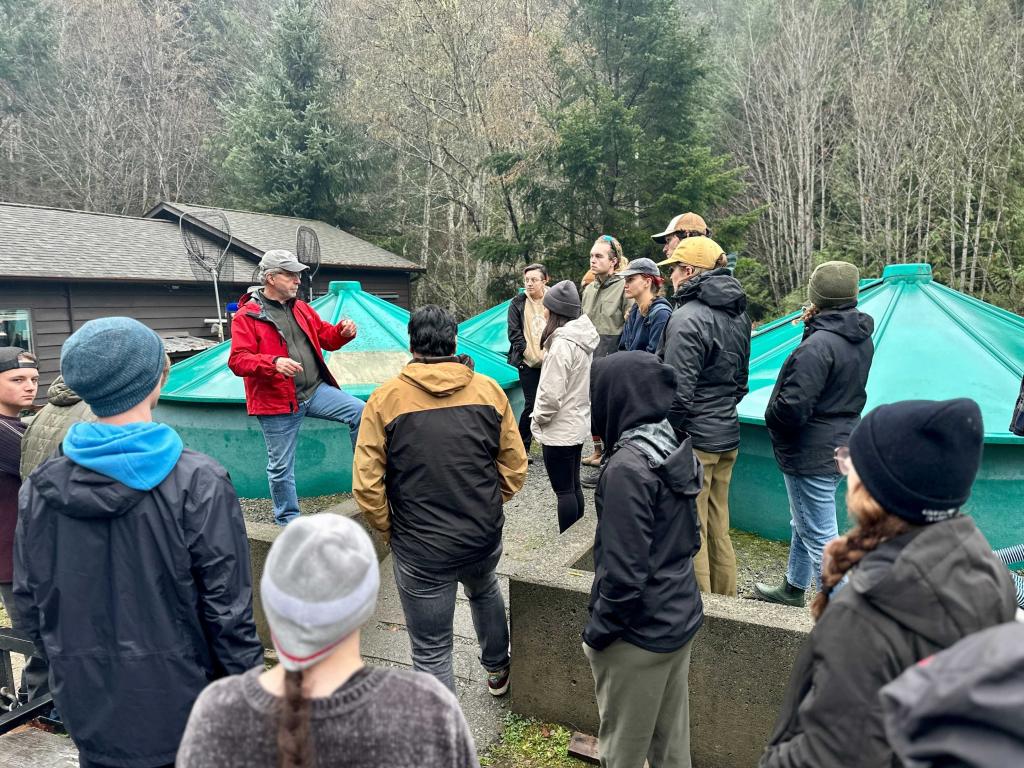
Hatchery-born Coho return on average 3 or 4:1 compared with wild Coho. Amid low returns, strategic enhancement is a temporary solution that does not address the root cause of declining populations, Lowen says.
Career aspirations and passions sparked through hands-on experience
Kestrel Guyon takes notes while students feed the hungry young salmon in a nearby tank.
“I’ve really been looking forward to learning how the operations work, the timing of things, and how they make sure there’s genetic diversity,” says Guyon, a certificate student.
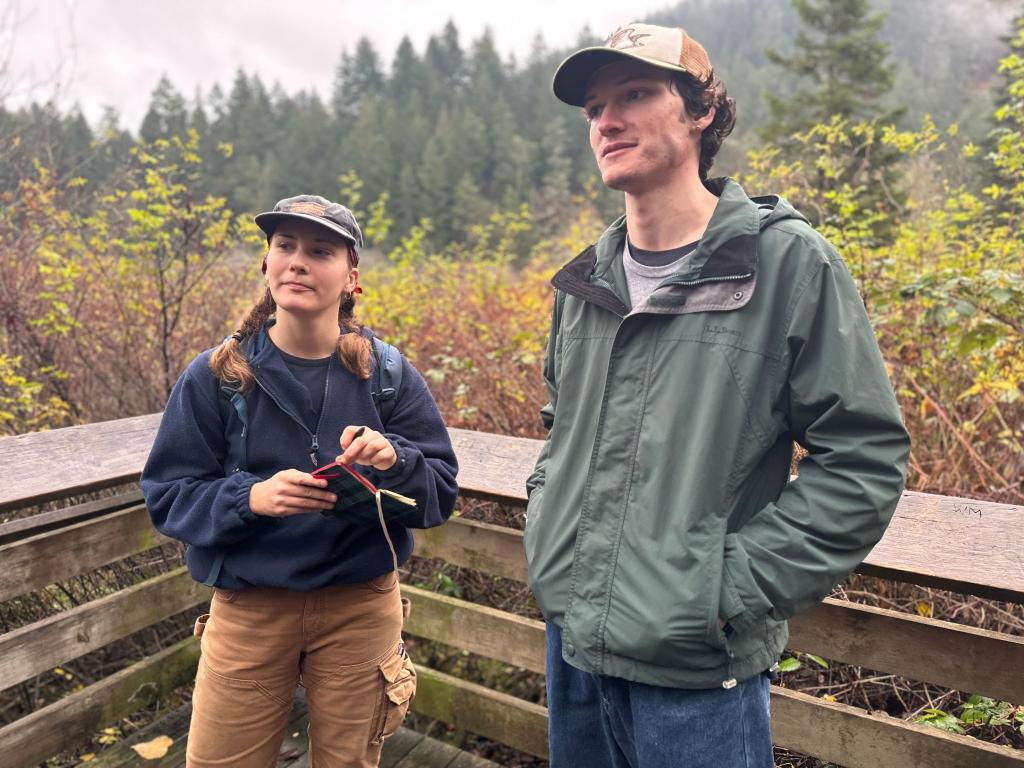
“I’ve learned you can come at [environmentalism] from a bunch of different angles,” says Kestrel Guyon (left). “That’s been really educational – seeing that you don’t have to be a scientist to be making big moves here.”
She says this excursion, one of many hands-on learning opportunities she’s had in the first few months of the program, has exposed her to career opportunities she never considered.
“This program has opened my eyes a lot,” she says. “Like there’s a bajillion different jobs and angles that you can take to make a good contribution so now I feel like I am less narrow with what my idea to do was but it’s good. It’s opening my eyes in a good way.”
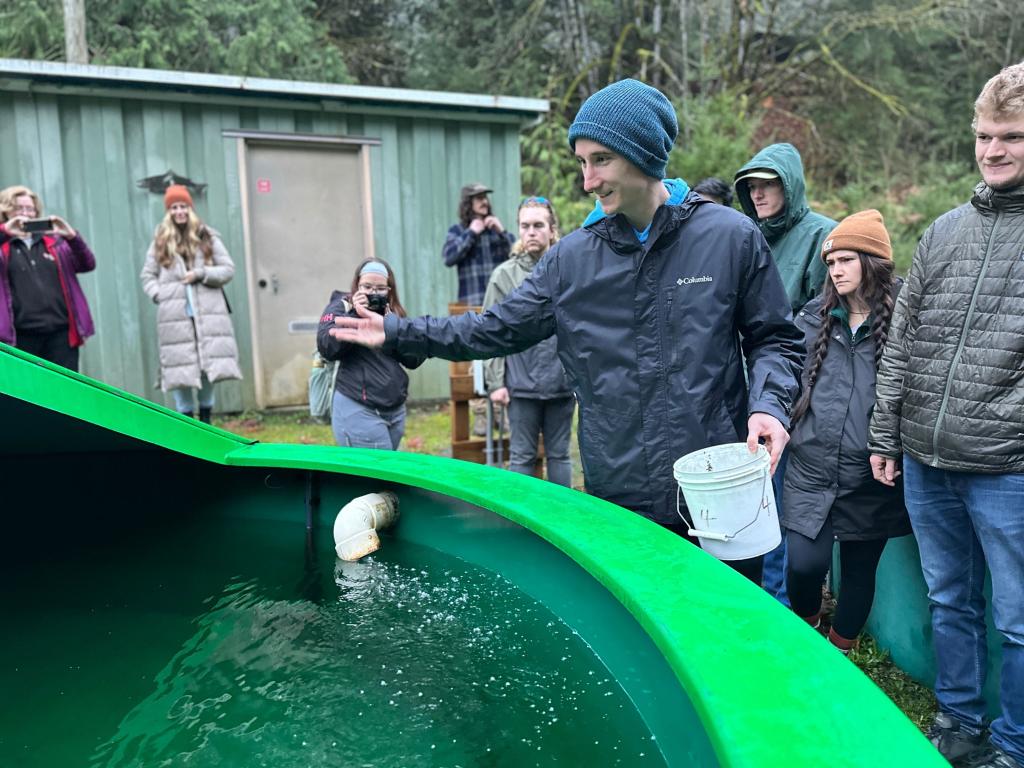
In the early days of the program, students build foundational concepts that will support their future work. Pairing theory with engaging activities helps remind them why they care, Moran says.
That, along with a deeper connection to the natural environment, is what Moran says she hopes students take away from today (along with a full notebook and camera roll).
“You’re going to work a lot harder if you have an emotional connection to something and the only way you develop an emotional connection is by understanding it and experiencing it,” Moran says. “So part of this is really to ground all students in the local ecosystem so that they develop that emotional connection and then they hopefully will feel a great sense of purpose in what they’re doing and why they’re doing it.”
Learn more about the Undergraduate Certificate in Applied Environmental Sciences and the Bachelor of Science in Environmental Science.