
Perrella delivers keynote address at Raised Voices Conference
In the courses Elvira Perrella teaches in the Global Learning and Language Centre at Royal Roads University, she strives to bring the world‘s current events into the classroom.
She used that same approach on the other side of the world to bring not only global perspectives but light and hope to university students in Zambia.
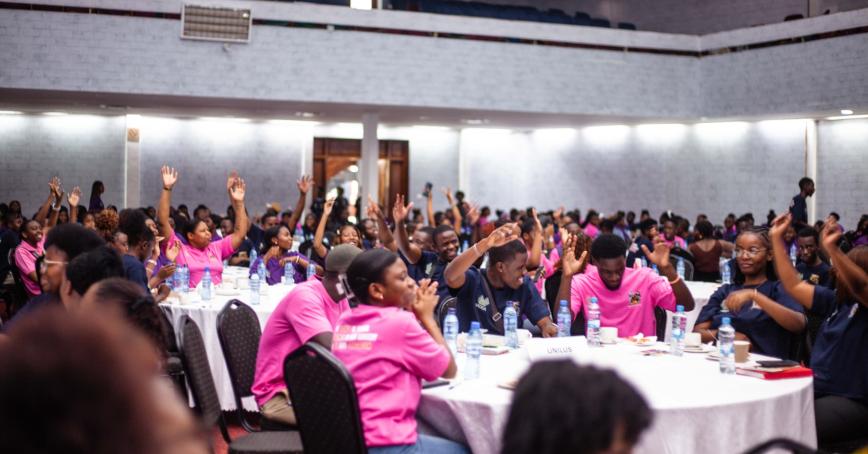
Perrella delivered the keynote address at the Raised Voices Conference on Gender-based Violence and Sextortion in Lusaka, the capital city of Zambia. The event was hosted by VIDEA, an non-governmental organization (NGO) NGO based in Victoria, BC, and the Nyapachuma Memorial Foundation, of which she’s a board member.
Addressing more than 400 students from seven universities, along with university deans and staff, representatives from NGOs, the national police and legal aid organizations, Perrella spoke about gender-based violence (GBV) and sextortion in institutions of higher learning in the southern African nation and in Canada.
Indeed, Megan Domenichelli, director of the RRU Global Learning and Language Centre, says Perrella’s work underscores the centre’s commitment to inclusion, ethical leadership, and global engagement and awareness, and reflects the deep expertise and advocacy its instructors bring to their teaching at Royal Roads.
“We’re proud to see Elvira’s expertise recognized on an international stage,” Megan Domenichelli, director of the RRU Global Learning and Language Centre says. “Her keynote in Zambia reflects the GLLC’s values of inclusion, global citizenship and education for positive change.”
Domenichelli adds Perrella’s work underscores the centre’s commitment to inclusion, ethical leadership, and global engagement and awareness, and reflects the deep expertise and advocacy its instructors bring to their teaching at Royal Roads.
Power imbalances behind GBV and sextortion
A form of GBV, sextortion often involves people in positions of power coercing victims into sharing explicit images online or engaging in sexual activities in person, threatening to expose the victim if their demands aren’t met. The perpetrators may even ask for money to keep the secret.
“Economic vulnerability and gender power imbalances make students, especially young, rural women, more at risk,” Perrella told conference attendees, adding, “Reporting remains low due to stigma, victim-blaming and weak legal protections, allowing the issue to persist largely in silence.
“It is rampant in universities [in Zambia], where especially girls are sextorted for academic favours such as grades, access to resources, admissions to programs or other advancements,” Perrella says. “Unequal power structures rooted in colonization have perpetuated gender inequalities and negatively impacted fair and safe access to education, leaving the most vulnerable at risk, especially women from rural communities.”
“The legacy persists in Canada, too, impacting Indigenous women, women of colour, women with disabilities, international students and members of the LGBTQIA+ community."
The effects are devastating for the victim, she says. Mental health impacts include depression, anxiety, shame and thoughts of suicide, resulting in fewer young women completing their schooling. In some cases, students die by suicide or experience physical impacts including HIV/AIDS, sexually transmitted infections, unwanted pregnancies and unsafe abortions, which have broader public health implications.
Victims, their families and communities affected
It’s important to note that effects don’t stop with victims of GBV. Many students from rural areas are supported by families and communities with the expectation that they will repay that support as they advance in their careers, failing to complete their schooling has far-reaching economic impacts on their communities and society at large.
Further, those who have fallen prey to GBV and sextortion and become infected with HIV/AIDS, STIs, or experience unwanted pregnancies can be seen to bring shame to their families and may then be ostracized by their relatives and communities, Perrella says.
“And it's not even their fault. They're coerced into these transactions, and they're threatened. They fear that they don't have a choice.”
Accountability and prioritizing students are key
Solutions should emphasize accountability, she says, including enforcement of policies for fair and equitable education, where they exist, and implementation of such policies where they don’t.
But all efforts toward solutions must start with prioritizing students over institutions and their reputations.
In attempting to spur change in Zambia, Perrella is echoing her approach at Royal Roads, where she aims to help student see their learning through a global lens and through their ability to make the world a better place.
Her hopes for them: “That they are treading lightly, they're conscious and aware. Their minds are open. They're thinking. They’re informed.
“If they can go out into the world and be more of the solution, rather than the problem, then I will have done my job.”