
Clear path in environmental protection flowed from murky waters
Topics
Featured
Share online
Applications for the 2026 Award for Diversity and Community Building are open March 1 through May 1, 2026. Learn more and apply.
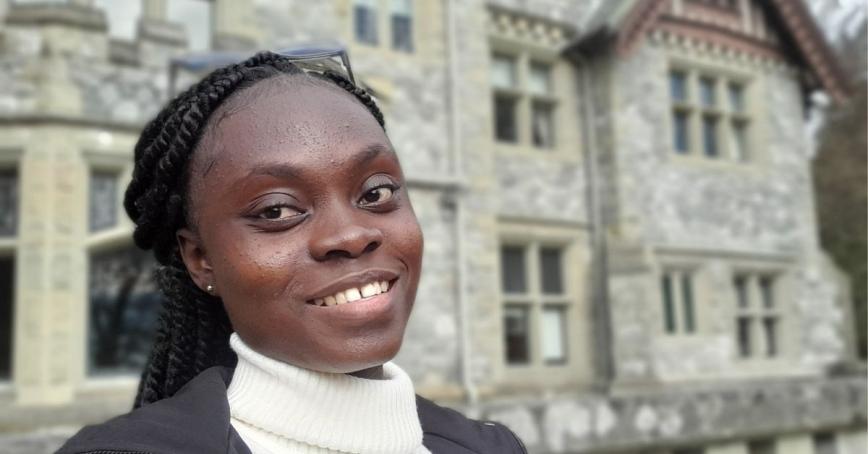
You could say Debbie Essien has always been an environmentalist. She says her defining moment came when she was 10 or 12 years old.
Growing up in Ghana, West Africa, the Master of Arts in Environment and Management student frequently travelled from her home in the country’s Western Region to the capital, Accra. On one such occasion, she remembers noticing the once-clear River Pra had turned brown.
“It had been clear, very clear,” she says.
The River Pra is one of Ghana’s major rivers, stretching 240 kilometers through rich farmland and forests in the country’s south.
Curious, she asked her mother about it, who told her illegal gold mining in the area was to blame.
“I started reading more and listening to the news,” she recalls. “That was where my interest started.”
Leadership and community building in action
Today, the river remains at risk. While locals say they could once see fish swimming through the clear waters, artists can now use the river’s thick, brown waters as paint to depict the environmental degradation.
The fire to protect Ghana’s natural environment, first sparked so young, only grew in Debbie. She completed her Law degree at the University of Ghana, and now, is completing her graduate degree at Royal Roads, with the goal of pursing environmental law or analysis.
In 2025, she was recognized with the 2025 Award for Diversity and Community Building, an annual $1,000 award to recognize students of Afro-Heritage descent who serve their communities through volunteering, applied scholarship or leadership.
Debbie stands out as a powerful example.
An active volunteer in Ghana, she took part in tree planting and beach cleanups and helped educate communities about the risks of using water from polluted streams. In addition, she provided legal representation for communities whose farmlands were destroyed by mining companies, at no charge.
“It’s great to know that there is someone who recognizes you.”
Receiving the award has been motivating, she says.
“It’s great to know that there is someone who recognizes you and appreciates what you are doing.”
The award was established by Master of Arts in Tourism Management alum Donneil McNab, with the intention of providing deliberate support to Black students in academic spaces.
McNab says she felt a responsibility to do what she could to support the Black community.
“Creating this award was my way of saying that Black students should not have to shrink to belong. If we believe in Black excellence, then we must build structures that support it, even if they are small at first,” she says.
Her hope is that the award reminds students they belong.
“[Black students] have every right to take up space and fully engage without feeling the need to dilute or defend who they are,” McNab says. “Even modest support can ... signal that someone thought about you intentionally, and that carries more weight than people often realize.”
Giving helps students keep going
Rebecca Sharma, director of Advancement and Alumni Relations, says McNab’s generosity, and that of donors like her, set a powerful example of how philanthropy can drive lasting change.
“The Award for Diversity and Community Building recognizes students who are making a real difference. It sends a clear message that their voices matter and that their leadership is essential to our community,” she says.
And for Debbie, that means the world to her.
“It helps reduce the financial burden, allowing me to take all my courses. It will also support my professional growth and further my interests in environmental issues,” she says.
“It encourages you to keep going.”
Learn more about the Master of Arts in Environmental Management program.