
2026 Conference on Communication Ethics
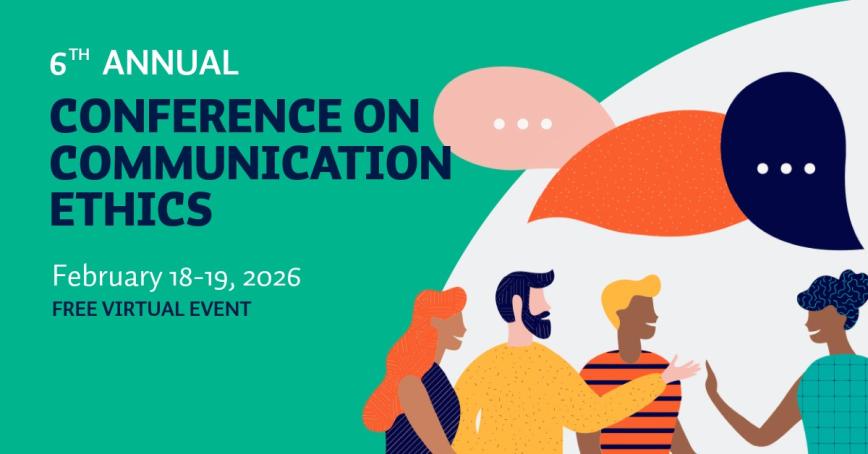
Register now for the Conference on Communication Ethics – free to attend!
The 2026 Conference on Communication Ethics invites thinkers, creators, and communicators to explore how communication can serve as a force for ethical change in an era of rapid technological shifts, political polarization, and rising uncertainty.
This free two‑day virtual gathering (February 18–19) brings together educators, researchers, students and professionals for dynamic keynote conversations, research presentations and panel discussions focused on truth, responsibility, and the future of ethical communication. Plus, an additional spotlight session on Professional Communication in Indigenous Contexts (February 20) offers a meaningful look at integrating Indigenous ways of knowing, relational ethics, and storytelling into communication curriculum and practice.
Join the conversation and help shape what ethical communication looks like today and for the future.
WHEN: February 18 to 19, 2026, 9 a.m. to 3 p.m.; PST daily
February 20, 2026, 1 p.m. (special session)
WHERE: Virtual event
REGISTER to attend—(free)
Your free registration gets you into any session or panel throughout the conference.
Here’s a sneak peek at the thought-provoking discussions we have planned.
Ethical Crisis Communications Under Stress – and in the Age of Artificial Intelligence
Timothy Coombs, advisor for the Centre for Crisis and Risk Communications, and Benjamin Morgan, senior associate of emergency management and crisis communication at Sandhurst Consulting, will explore the ethical dimensions of crisis communication when decision-makers are operating under extreme stress and when artificial intelligence increasingly shapes how messages are created, distributed, interpreted, and remembered.
Trust Isn’t Inherited Anymore: What Gen Z Is Teaching Us About Media Ethics
Iman Kassam, professor of audio and video at Seneca Polytechnic and alum of RRU’s Master of Arts in Professional Communications, presents their research about how young people assess credibility, negotiate skepticism, and navigate news within platform-shaped media environments. Framed through a communications ethics lens, the presentation invites reflection on transparency, accountability, audience labour, and the moral responsibilities of journalists and media organizations operating within algorithmically mediated systems.
Reparations in Canada: A Necessary Conversation for Collective Justice and Prosperity
Dominique Jacobs, executive director of the Vancouver Island Human Rights Coalition and alum of RRU’s Bachelor of Arts in Professional Communication, will share a presentation exploring the topic of reparations in Canada, addressing why it is often ignored, why it is necessary, and how it benefits all of society—not just the Black community.
Sport, Leadership and Social Change
Jennifer Walinga, professor of Communication and Culture, is joined by experts in sport governance, leadership, advocacy, reporting, and policy making to discuss how Canada is navigating the road to values-based sport.
Ethical Challenges in Professional Communication
Susan Gee, vice-president external relations at RRU, Corinne Thiessen, manager of corporate and brand communications at British Columbia Investment Management Corporation, Rebecca Bultsma, AI ethics researcher at Amplify and Elevate Innovation, and Geo Takach, professor of Communication and Culture at RRU, will discuss ethical challenges arising in the practice of professional communication today. Drawing on their diverse experiences, they will cover contexts for such challenges such as rampant and constantly changing communication technologies, the ‘post-truth’ environment, geopolitical aggression and uncertainty, social and economic instability, and looming environmental disasters.
A Blackfoot Winter Count: Implications of Indigenous Place-Based Learning for PR/Communication Education
Timothy Kenny, senior communication advisor for Parks Canada, presents a journey through Blackfoot and Indigenous methods, including story work, while exploring the implications towards decolonial public relations and communication scholarship—and ultimately practice.
The Value of a Degree or Certificate in Professional Communication
Emara Angus, digital communications officer at RRU and alum of the Graduate Certificate in Professional Communication Management, Sharad Kharé, founder of Human Biography and Master of Arts in Professional Communication alum, Michelle West, senior director of Membership, Marketing and Communications at ACEC-Ontario and first-year MAPC student, and David Black, associate professor of Communication and Culture, will discuss how their education has shaped career pathways, strengthened employability, and supported professional growth across sectors such as public relations, marketing, digital media, public engagement, organizational communication, and documentary film.
What Artificial Intelligence (AI) won't replace; The Power of Connection
Barb Collombin, associate faculty of Communication and Culture, and Peter Bombaci, founder and CEO of GenWell, will explore the power of human connection through the story of GenWell Canada. Collombin and Bombaci will discuss how intentional connection can improve wellbeing, strengthen communities, and help us navigate an AI-driven future without losing what makes us human.
Ethical Artificial Intelligence in Teaching in Learning
Donna-Marie Hamilton, Instructional Designer with the Centre for Teaching & Educational Technologies at RRU, examines what it means to use generative AI ethically in teaching and learning. It explores the interconnected challenges educators face as they journey to integrate AI tools responsibly while protecting data privacy, mitigating algorithmic bias, and fostering critical AI literacy.
For the Land | For the Future
Erynne Gilpin, assistant professor of Communication and Culture, explores how decolonial research methods intersect with multimodal storytelling practices in film-based scholarship. Drawing on relational ethics, Gilpin examines how film production can function as a form of knowledge mobilization that supports community accountability, cultural protocol, and local governance.
Artificial Intelligence and Ethical Communication Practices in Post-Secondary Education: Developing Professional Guidelines
Peter Ryan, associate professor of Public Relations at Mount Royal University, Lauren Dwyer, assistant professor of Information Design at MRU, Rey Rosales, associate professor of Communication at MacEwan University, Archie McLean, associate professor of Journalism and Digital Media at MRU, and Alex Sevigny, associate professor of Comunications Management at McMaster University, will discuss, as a panel, questions to further understanding of institutional and Communication Studies changes concerning AI ethics and practices.
‘This Is Not Normal’: Communication Ethics and Alberta Separatism
Geo Takach, Professor of Communication and Culture at RRU, and Duane Bratt, professor of Political Science at MRU, will together explore the ethics of public communication surrounding the historically entrenched and recently resurgent question of separatism in Alberta. This session considers how narratives of separatism are constructed, amplified and contested across contemporary political discourse, journalism and digital platforms.
Second Gathering on Professional Communication in Indigenous Contexts
This session will focus on how post-secondary communication programs can meaningfully incorporate Indigenous knowledge systems, truth-telling practices, and ethical approaches to technology and communication into curriculum design. Grounded in Indigenous perspectives, the afternoon conversation will explore curriculum changes that might better focus on relationality, collective responsibility, storytelling, and community accountability as core communication competencies.
This session has an in-person option that requires a separate registration. If you plan to attend the virtual session, you may register here.
About the Second Gathering
Overall, the Second Gathering asks: How can we support new communication tools that serve current and future generations?
Indigenous truth-telling has long been a practice of communication grounded in collective memory, community care, and social justice. Before colonization, truth was shared through storytelling, with Elders offering perspectives that shared history and knowledge across generations. In many Indigenous cultures, truth is not a matter of opinion, but a shared and collective understanding.
In contrast, modern communication in a post-truth society increasingly blurs the line between fact and fiction. Algorithms often amplify division rather than empathy, while social media platforms fail to protect against misrepresentation of science, research, and history. As a result, democratic institutions are eroding, and global conflicts and systems of imperialism are intensifying.
Long before colonization, Indigenous nations across Canada practiced sophisticated forms of democracy—such as the Haudenosaunee Great Law of Peace and the consensus-based governance systems of many BC Coastal First Nations. As educators and practitioners in the field of communication, we are now witnessing resistance to certain commercial social media platforms. Indigenous perspectives on communication, technology, and truth offer a powerful way forward and may help shape a new chapter in the field of professional communication and communication education.
Register now for the Conference on Communication Ethics – free to attend!