
Leading without limits
Topics
Featured
Share online
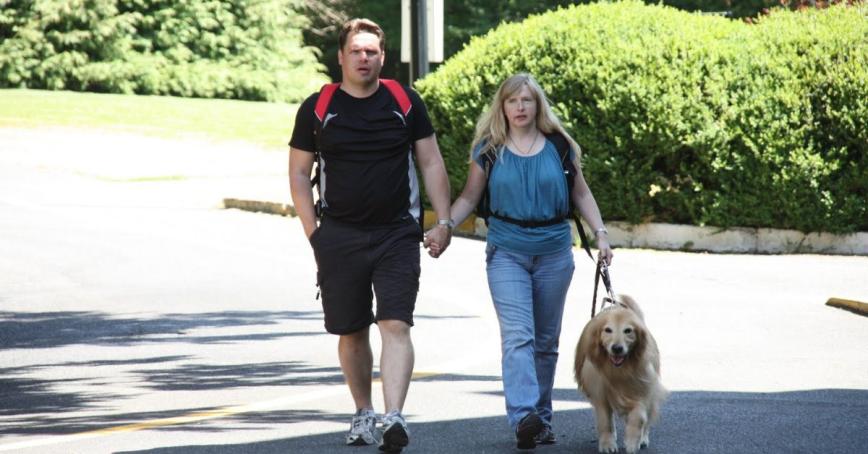
Diane Bergeron receives an honorary doctorate from MacEwan University at its Spring 2026 Convocation ceremonies for her unwavering advocacy to advance inclusion and accessibility for people across the country.
Learning to lead where it mattered to her changed the trajectory of Diane Bergeron’s life.
From professional impact grounded in the classroom to reaching new heights – literally – in what she was capable of, Bergeron is quick to point out two very important lessons from the Royal Roads University Master of Arts in Leadership program.
The first lesson
At the start of the program, Bergeron, MA Leadership , was worried about how her vision loss would affect both her experience and her classmates’. Diagnosed with retinitis pigmentosa at the age of five, she was legally blind at 10 and lost all sight in her 30s.
As she became engrossed in the work, there was a lesson to be learned in asking for help and understanding her contributions.
After a late-night spent converting materials into accessible formats, her learning partner Randall Heidt commented on how tired she looked. It hadn’t occurred to her to ask for help, but Heidt was quick to point out that by not doing so, she was impacting how much he was learning from her.
“It was actually that statement that made me realize it wasn’t just me taking from him and the teachers and classmates,” she says. “Everyone talks about how it helps the person with the disability to be integrated, but having someone with a disability in the program is also helping others to learn.”
Learning to lead and trust
As Royal Roads University marks the 30th anniversary of its Master of Arts in Leadership program, alumni like Bergeron demonstrate how its approach to self-reflection and leadership styles translates into real-world impact.
“It didn’t matter anymore what my title was or what the job was. What I really wanted was to create an environment in the world that was going to increase the quality of life for people with disabilities.”
For her, the relationship between a blind person and their guide dog is the perfect example of the leadership journey. Bergeron trusts her dog Carla to get her where she needs to go just as much as Carla trusts her to provide the information she needs to do her job.
“I have a destination in mind, and I give my dog a cue,” she says. “Once I give that cue, the dog becomes the leader and I become the follower. It’s that inter-dependency of the leader and the follower, and the only way for the relationship to function is to have 100 per cent trust in each other.”
She invested in the program to advance her career opportunities and came out of it with a new perspective.
“A leader is how you interact with everyone around you,” she says. “What mattered was how I could be a leader in any space, that I could influence without [a specific job title]. That changed the trajectory of what I did.”
The work that matters
After graduating from RRU, Bergeron joined the CNIB team. She has been there for 14 years, now serving as Head of Global Strategies and Senior Vice President Public Affairs.
“It didn’t matter anymore what my title was or what the job was,” she says. “What I really wanted was to create an environment in the world that was going to increase the quality of life for people with disabilities.”
She has helped reshape Canadian copyright laws to expand access to accessible materials. For five years, she led CNIB’s guide dog program and on an international level, she provided leadership through the World Blind Union (WBU), serving as both past Treasurer of the WBU and Chair of the WBU Women's Committee
“I love it when I can hear about someone who did one of our programs because of the efforts of the team I am on, or that they got a job or a dog that gave them freedom and independence,” she says. “That gets me excited – that a person gets a better life.”
The second lesson
Self-assessment work brought new understandings about trust and vulnerability. When she got home from her first residency, she was inspired to challenge herself.
Afraid of heights, she went tandem skydiving.
Bergeron says skydiving inspired her to think, “If I can jump out of a plane, what else can I do that would be a challenge for me?”
“It was such a cool experience that turned into me thinking, ‘If I can jump out of a plane, what else can I do that would be a challenge for me,’” she says.
She drove a race car. Rappelled down a 29-story building. And when her friends suggested she try a triathlon marathon, she laced up.
“I came second to last, but I made it,” she says. “I crossed the finish line. I was really realizing it doesn’t matter what I want to do, all I have to say is, ‘I want to do this’ and then figure out the steps to take to get there.”
For her 50th birthday, she competed in the 2015 Ironman Mont Tremblant. When soaring temperatures led her to withdraw from the race – after successfully completing the bike ride, open-water swim, and half the run – she was not deterred. She signed up again two years later and crossed the finish line.
“I would have never done any of that without the leadership program,” she says. “A huge thank you to Royal Roads, because they really did help me become the leader I wanted to be both professionally and personally. It was the program that built up that confidence that made me realize the only thing holding me back was me.”
Canada marks National AccessAbility Week each May. This story is part of a series of pieces on the important contributions of persons with disabilities and the ongoing movement toward a more accessible and inclusive Canada. Visit our National AccessAbility Week webpage for more stories, to learn about upcoming events and discussions, and to find resources.
Learn more about the Master of Arts in Leadership.