
Investing in change: unlikely doctoral candidate creates opportunity for others
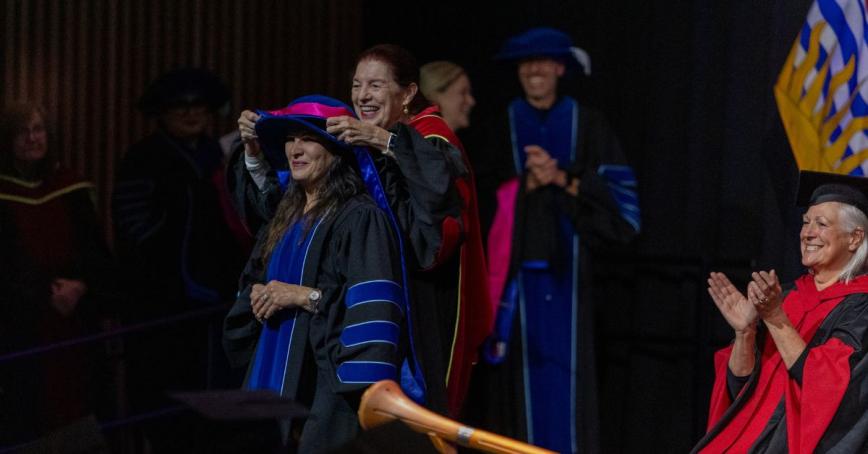
Learn more about the Doctor of Social Sciences.
As societies grapple with rising polarization and ideological violence, Valarie Findlay is asking a critical question: How do we better understand it to prevent it, especially in youth?
A graduate of the Doctor of Social Sciences program in 2025, she is now turning her focus to how group dynamics, social identity, and environment influence why individuals, particularly youth, can be drawn to extremist ideologies.
“There is a huge gap in social policies in how we foster societies that create an environment for youth that gives them better reasons to not engage in anti-social behaviour,” she says. “I started looking at behavioural assessment at the group level … and what we see with youth when they get involved in these groups (like incelism, white supremacy, and gender and race extremist groups).”
Refining focus, protecting young people
Seeing a significant gap between institutional responses and real-world needs, she started the Ideological Violence and Youth Resource Network — IVY for short. It’s an online space for parents, educators, community, and public leaders to better understand how social ideologies can impact, influence, and change youth’s thinking and actions. It’s a way to share information, offer mentorship, and protect youth at the first signs of ideological influence, she says.
“This was one of the gaps. Currently, there are waitlisted programs or parents can call the RCMP,” she says. “We want to make sure we have sociologists and experts in the middle of these options to give parents the tools to figure out how critical the situation with their kid is.”
Findlay pursued her doctorate mid-career after decades working in national security and intelligence. She founded and continues to lead TIGIR and HumanLed, which focus on counter-terror research in cybersecurity, infrastructure security, and public safety and policy. As part of that work, she examines the impacts of terrorism on legislation, government, industry, and federal and community law enforcement.
Giving back for meaningful change
As she completed her doctorate, Findlay started thinking about how to give back. Inspired by the experiences of her peers – many of them Indigenous women navigating systemic and geographic barriers – she established the Findlay Doctoral Bursary. The award supports Indigenous graduate students whose research focuses on decolonization or ideological violence.
As an unlikely doctoral candidate — Findlay left high school after Grade 8 and came back to education on her own time — she is passionate about creating opportunities for others to find learning that works for them and offers diverse perspectives.
Committing to a legacy gift is more than a gesture of gratitude. It says, ‘I support and care about RRU’s greater offering — a progressive, inclusive, rich community that promotes the positive advancement of our societies.’”
“That shapes how they contribute to society and who they become as employers and leaders,” she says. “Understanding and developing sensitivities around important social issues can’t be an afterthought. Organizations don’t contribute to society; the people in the organizations do.”
Findlay has also left a legacy gift to Royal Roads in her will, ensuring that support continues for students for years to come.
For her, the connection between education, research, and social impact is clear. Meaningful change starts with understanding and is sustained through action to find artful ways to improve the world around you, she says.
“Committing to a legacy gift is more than a gesture of gratitude,” she says. “It says I support and care about RRU’s greater offering – a progressive, inclusive, rich community that promotes the positive advancement of our societies.”